
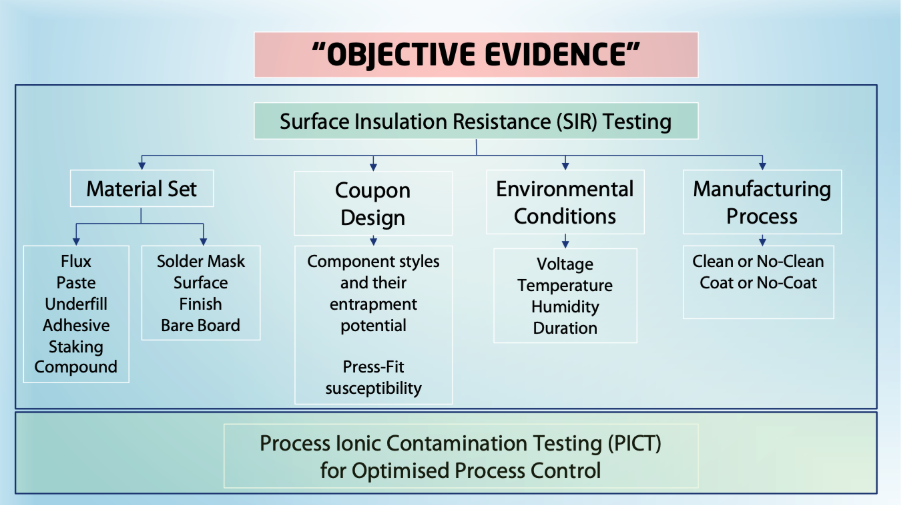
PROCESS CONTROL
These are the highlights from the NEW IEC 61189-5-504:2020 Process Ionic Contamination Test (PICT) represents the most significant overhaul of what became known as the ROSE test.
Originally, the ROSE test was intended to be used as a Process Control test, never as a cleanliness test.
To help appreciate the differences, here is a brief “walk-through” of the IEC PICT Standard:
- Test Technique
- Ratio of specimen to test solution is 10 ml/cm2
- Solution type
- Sensitivity
- Flux chemistries / contaminant types
- Calibration
- Sensitivity
- Solution temperature
- Test Duration
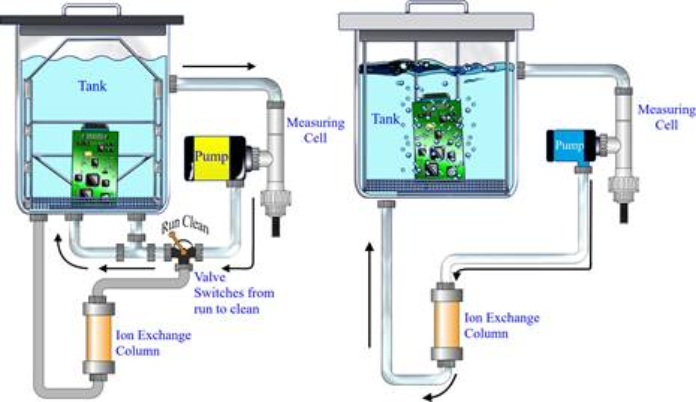
CLOSED LOOP OPEN LOOP
Static v Dynamic Test are misleading terms. They came about originally to by-pass Patents that existed at the time.
In truth, the test should be regarded as Closed Loop (Static) v Open Loop (Dynamic)
Closed Loop – The test solution in the test chamber is pumped via the regenerating filter, until it reaches a pre-determined level of conductivity.
The test specimen is introduced into the test chamber and the test solution begins to recirculate, bypassing the filter.
Open Loop – The test solution in the test chamber is pumped via the regenerating filter until it reaches a pre-determined level of conductivity.
The test specimen is introduced into the test chamber and the test solution begins to recirculate, through the filter.
A volume of test solution >10ml/cm2 will greatly reduce the system sensitivity and therefore produce either False Positives or False Negatives.
Ionic soils can be dissociated in water, and the conductance measured to give an indication of the contaminate level. The test solution however is more than just water; it contains propan-2-ol, a non-polar liquid that aids the dissolution of the soil and, as a non-ionic hydrophilic solvent, its presence does not influence the reading except insofar as it "dilutes" the water bearing the dissociated ions. The test employs a test solution that comprises a specific ratio of 50 % V/V propan-2-ol and 50 % V/V deionised water or 75 % V/V propan-2-ol and 25 % V/V de-ionised water.
The 50:50 mixed solution is an optimal compromise between the sensitivity and the solvency when using immersion test methods.
The 75:25 mixed solution with the higher alcohol content will reduce sensitivity but increase solvency and vice versa with respect to water.
The detection of ionic impurities in water uses a well-established conductivity test method. The electrical conductivity of pure water is 0,055 μS/cm at 25 °C. This value is temperature dependent.
The addition of 1 x 10⁻⁹ parts of NaCl increases the conductivity of pure water from 0,055 μS/cm to 0,057μS/cm at 25 °C.
Propan-2-ol, also commonly known as iso-propyl alcohol (IPA), is used to increase the dissolution of ionic material that is inorganic in nature and trapped by an organic residue.
The instrument should be capable of avoiding polarisation effects between electrodes such as those that can occur when using DC test currents. Equally, error signals caused by both DC and AC currents should be avoided to ensure optimum accuracy at low conductivity values.
No perfect or easy solution toward Objective Evidence. The instrument must be sensitive enough to detect variations within the assembly process. The GEN3 CM+ Series have equal or even superior sensitivity to Ion Chromatography.
The measurement system shall have an accuracy of ±0,05 μS/cm.
The instrument should be capable of avoiding polarisation effects between electrodes such as those that can occur when using DC test currents. Equally, error signals caused by both DC and AC currents should be avoided to ensure optimum accuracy at low conductivity values.
The conductivity of an ionic solution is determined using the following formula:
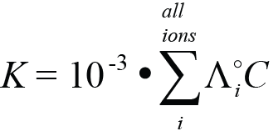
where
K is the conductivity (S/cm);
Λi° is the molar conductivity (S-cm2/mol) of ion i at infinite dilution;
Ci is the concentration (mol/l) of ion i
The measured conductivity is the sum of the conductivity from water and the conductivity from
the sodium and chloride ions.
The test solution is extremely temperature dependant
The linear temperature correction is widely used. It is based on the observation that the
conductivity of an electrolyte changes by about the same percentage for every °C change in
temperature. The equation is:
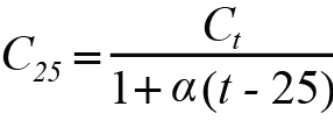
where
C25 is the calculated conductivity at 25 °C;
Ct is the conductivity at t °C;
α is the linear temperature coefficient expressed as a decimal fraction.
Although a single temperature coefficient can be used with reasonable accuracy over a range of 22 °C to 29 °C, accuracy can be improved by calculating a coefficient specifically for the sample temperature.
A maximum test duration of 15 min should be observed.
Because the test solution is de-ionised, it will aggressively seek out ions.
There are many different process steps involved in the manufacture of circuit assemblies, the majority of which include ionic species. There is always a risk of the leaching of ions from within the components, for example flame retardants used in the printed circuit board dielectric, because of the de-ionised solution on the test specimen. Many of these are required to ensure satisfactory performance of the finished circuit assembly. It is therefore necessary to minimise the risk of a leaching effect that will cause these ionic species to be "pulled" onto the circuit surface, even through the laminate and solder resist.
For this reason, a maximum test duration of 15 min should be observed.
When using an Open Loop (Dynamic) type system, this particular test technique accumulates data, generally requiring a far longer test duration than the recommended maximum of 15 min.
This measurement approach has been 6 Sigma verified and is able to identify changes in a manufacturing, assembly, process that will require further examination.
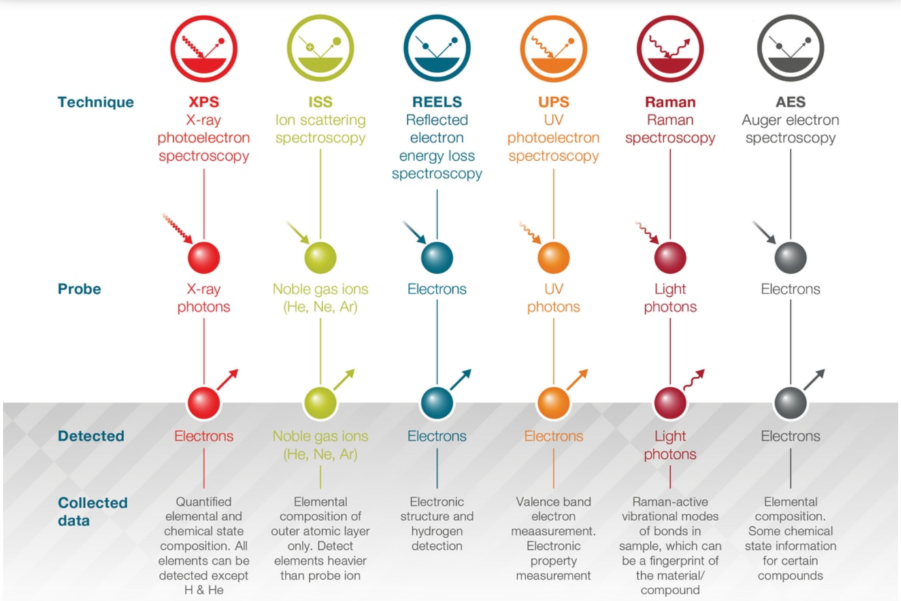
Such further examination is best described as a “tool-box” of various test techniques, the most common if which, is Ion Chromatography. As can be seen below, it is only one of many as per the examples show below:
The many extracts are provided Courtesy of the International Electrotechnical Commission IEC.
To obtain your own copy of the IEC 61189-5-504 PICT Standard, go to
https://webstore.iec.ch/publication/33194